

Hey folks 👋
At the moment, a lot of people (me included!) are talking about if, how and where AI is taking people’s jobs. In the process, a core hypothesis is emerging for so-called “knowledge work” — jobs that involve sitting at a computer, processing information and producing documents, analysis and decisions. The emerging hypothesis is that AI is absorbing the junior work first (Brynjolfsson et al., 2026; Lambert & Schindler, 2026).
In law, that looks like AI producing the first-draft contracts, research memos and document reviews that junior associates used to cut their teeth on (SurePoint Law School Hiring Report, 2026). In software, it looks like AI taking responsibility for the more simple, routine support tickets that used to go to graduate engineers (Brynjolfsson et al., 2026).
The question I’ve been exploring over the last couple of weeks is: is the same pattern happening in L&D?
In this week’s post I share my findings so far — with some striking insights on how the profession is and isn’t changing.
Let’s dive in!
The Analysis
To start to answer this question about the state of entry-level work in L&D, I analysed live job ads for instructional designers, learning designers, eLearning designers, learning experience designers, and L&D specialists and managers posted in the UK & US between June and August 2026.
Out of 379 live postings, only four were advertised as junior roles — that’s 1% of all roles.
For context, entry-level positions still made up around 37% of hires at large US employers in 2025 (LinkedIn Economic Graph, 2026). And for every junior-titled posting in my sample, there are twenty-eight senior-titled ones.
Is 1% low by historical standards? Here’s the uncomfortable answer: nobody was counting. There is no historical series of instructional design job postings — the US Bureau of Labor Statistics actually retired its occupational code for instructional designers years ago and folded us into an education category. Corporate instructional design doesn’t exist as its own occupation in official statistics. My study creates the first baseline.
But “no direct before-number” is not the same as “no before.” The best dated evidence we have is Peck’s 2023 survey of over a thousand working instructional designers: at that point, 53% of people in the field had been in it for under three years — up from 44% in 2021 — and their salaries had risen 8% (Peck, 2021; 2024). That survey’s audience skews early-career, and it measures who was in the profession rather than open roles. But the direction is hard to misread: as recently as autumn 2023, L&D was absorbing newcomers at scale — and paying more each year to get them.
Extrapolate this pattern out and the shape of L&D changes dramatically. Today the profession is bottom-heavy: half its people were new to the field as recently as 2023, most of them hired to do what juniors have always done — producing drafts and doing admin.
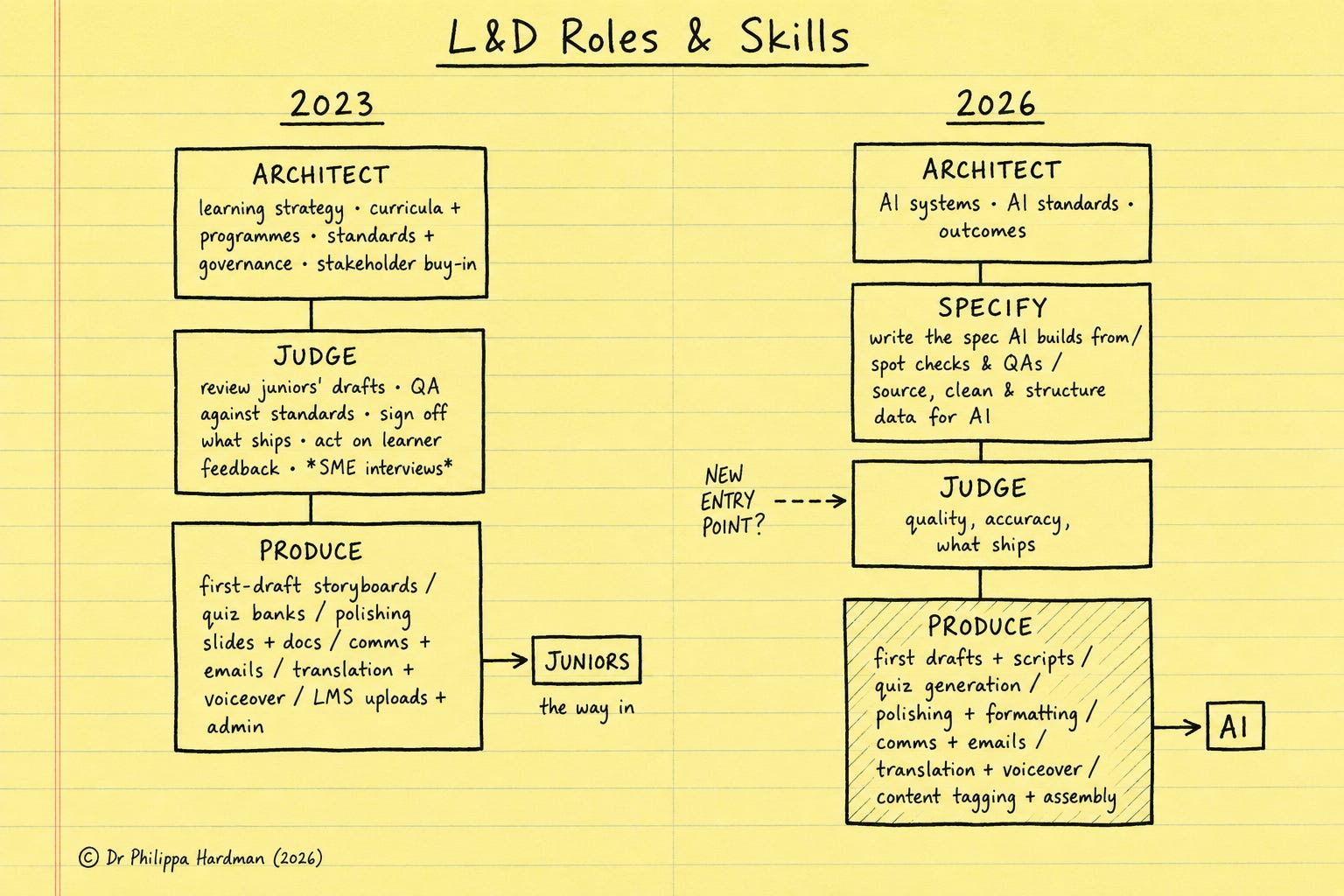
But a hiring market in which only 1% of roles are junior redraws that picture fast. By 2027–28, today’s newcomers have aged into mid-career, and the work they entered on is increasingly done by AI, not by a new intake of juniors. What humans are hired to do concentrates further up the ladder. The field stops being a pyramid of people with production at its base and becomes a thinner column of specifiers and judges sitting on top of an AI production layer.
TL;DR: the bottom rung of L&D isn’t just narrowing — it’s being automated. The humans who remain move up the ladder, and the profession re-forms around a new set of AI and domain specialisms.
The Role of AI in Removing Junior Roles
Is AI responsible for reshaping knowledge work, including L&D? My hypothesis is a resounding YES, primarily because of what I see in L&D job ads in 2026:
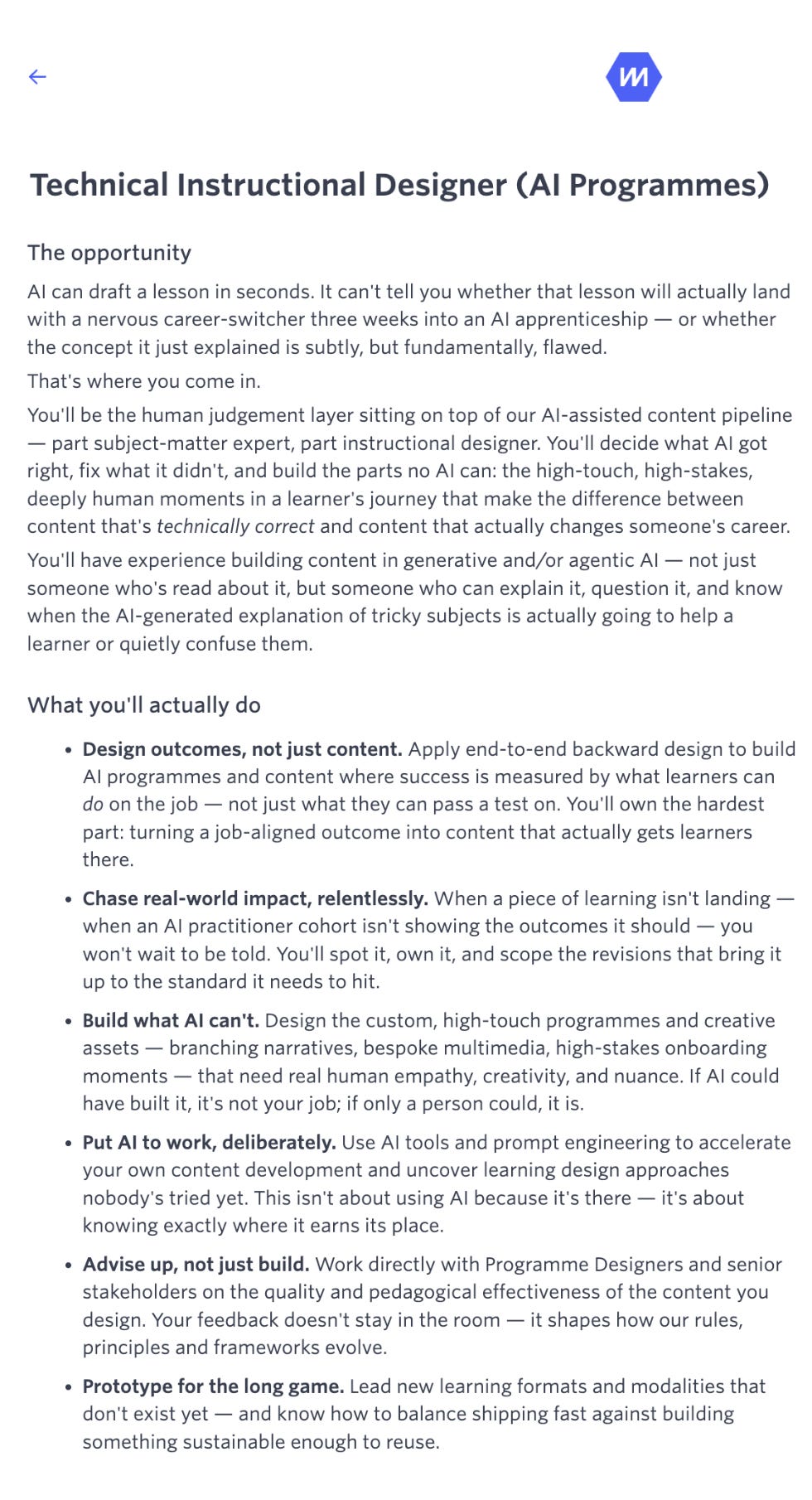
Multiverse’s ad is built on the premise that, “AI can draft a lesson in seconds”. The role of the human is not to produce stuff (i.e. what juniors used to do), but to be “the judgement layer sitting on top of our AI-assisted content pipeline.” The drafting is AI’s; the human L&D role is judgement and direction - i.e. a traditionally mid-career managerial role.
Motorola Solutions’ ad requires its L&D team members to use Gemini, ChatGPT and NotebookLM “to accelerate development and scale content creation”. The human’s role is to verify the quality of and then tag content, so AI agents can serve it up as performance support. Product is delegated, expert judgement on quality is what humans bring.
Amazon’s recently-listed Learning Experience Designer will wotk with AI as the default rather than an add-on. Humans “use generative AI to draft, iterate, localise, and scale content” — the same four verbs that formerly make up a junior’s job description.
At Coursera, a recent job ad describes a designer who doesn’t build at all: AI produces, and the designer’s job is to check and own the quality of what comes back. Again, what used to be junior work is now AI work.
Meawhile, AI usage data says these ads describe the norm, not the vanguard: 63% of L&D teams now use AI to produce voiceover, 60% for content and quiz drafting, 52% for video, 38% for translation — and 84% cite faster production as AI’s main benefit (Synthesia, 2026).
The wider evidence fits the same shape. Stanford’s Digital Economy Lab, for example, recently reported that employment among 22–25 year olds is running 19% below its expected level — with under-employment concentrated exactly where AI automates tasks (Brynjolfsson et al., 2026).
Important caveat: the “AI is taking junior roles” argument remains genuinely contested, and it’s worth knowing the strongest counter-arguments. For example, The Broken Ladder — a 2026 working paper from researchers at Warwick, LSE and Oxford’s Ellison Institute, built on 243 million hire records across four countries — note the economy-wide junior decline began in early 2022, before ChatGPT. This suggests that AI may be being used as a mechanism to continue and expand a trend rather that was already underway rather than what instigated the change in the first place.
But whether AI took the work, or made the trainee uneconomic, or both compounded — the outcome for the profession is identical: the bottom run if disappearing rapidly.
What This Means for How We Train L&D Folks
Last week’s post laid out how some of L&D’s biggest employers are responding by re-engineering on-the-job training — getting new hires “judgement ready” in weeks via deliberate practice, rather than years of real junior work. But what does this shift mean for formal ID training — the degrees?
Every L&D master’s degree is really made up of three things: a science (learning theory, ID foundations, evaluation), a studio (courses where students personally craft the assets), and a toolkit (the technologies — historically, authoring tools like Storyline and Captivate). Take a representative example — Florida Gulf Coast University’s MA core for 2026, which covers Foundations of ID and Universal Design for Learning on the science side, Visual Media for Learning and Interactive Learning in the studio and Foundations of Learning Technology for the toolkit (FGCU, 2026).
Read against emerging job ads, all three elements of formal L&D training face different futures:
The science survives and expands because it’s the substance of the two skills the market now pays a premium for: specification and judgement. You cannot write a brief for what “good” looks like, or spot where a fluent AI draft is subtly wrong, without learning theory, design foundations and evaluation to judge against. The theory core stops being the academic preamble to the practical work — it becomes the practical work.
The studio inverts and reduces because its founding assumption — the designer personally crafts the asset — is now false for most of the market. The hours students once spent building media shrink; what replaces them is the loop the new jobs actually run: write the spec, let the system generate, critique what comes back against your own standard, revise. Same artefacts in the room — but the graded work becomes the spec and the critique, not the asset.
The toolkit reshapes because the tools themselves have changed category. Storyline and Captivate still appear in a third of my 379 ads, so the authoring suite remains the price of entry for most jobs today — but not one of the fifty tools-forward ads describes a judgement-built role, and the leading edge names a different stack: Gemini, ChatGPT, NotebookLM, and the prompting, tagging and content-structuring skills to direct them. The toolkit module doesn’t disappear; its contents rotate from tools you operate to systems you direct
Then there’s what’s simply missing, because it’s too new: spec-writing for AI systems as a first-class skill, and structured critique of AI output with feedback on the critique itself.
In somple places, the review has visibly begun. USC Rossier has launched a new master’s with AI in its title — Learning Design with AI and Emerging Technologies. Wilkes University announced a revised instructional technology curriculum this June, including a concentration built specifically for corporate L&D. San Francisco State now advertises AI integration across every course in its IDT master’s.
But here’s the test I’d apply to every one of these redesigns: has the studio actually inverted, or has AI been bolted onto a production curriculum? Adding AI tools to asset-making courses updates the toolkit; it doesn’t change what the student is graded on. Until the graded work shifts from the course / media portfolio to the spec the students wrote for AI and the critique they gave about AI’s work, the degree is still training people for the 81% of the market that’s rapidly shrinking.
If I ran one of these programmes, my one-line brief would be: keep the science, invert the studio, rebuild the toolkit. The theory is the durable asset — teach more of it, not less. The studio and toolkit are where the most substantive rethinking and reshaping of L&D training is needed urgently, but also where change is least visible.
Conclusion: The Ladder Won’t Rebuild Itself
Pull the three threads of this post together and the picture is pretty stark. The data shows that junior entry into L&D went from widespread and routine to pretty much residual in under three years. The emerging reality in L&D — as per knowledge work more broadly — is that AI now does the work juniors were historically hired to do, and humans are hired for what sits above it: specifying, judging and measuring.
My hypothesis is that what we’re witnessing is a classic example of a profession professionalising. L&D work is going from a craft you learned by doing — producing courses, mastering tools, making things — to a discipline you’re trusted to exercise: diagnosing problems, specifying solutions, judging quality and measuring impact. Other fields have made this journey before us; what’s different this time is the speed, and the fact that the machine driving it also removed the traditional way in.
The biggest question that all of this this raises for me is (once again): how do we prepare entry-level L&D folks for this new, emerging entry-level work?
Historically, the junior work — the first-draft storyboards, the quiz banks, the polishing and production — wasn’t just labour; it was how the profession created its experts through cycles of doing, feedback & observing. Judgement — the skill that the market now pays a premium for — was built by doing the work that AI increasingly does for us. Remove the bottom rung and you don’t just close a door for juniors: you also switch off the machine that manufactured the seniors.
My biggest concern in all of this: nobody owns this problem. Of 379 job ads, not one asks anyone to design the replacement for the apprenticeship AI just removed — no employer I can find is hiring for this. And while a first wave of Master’s degree redesigns has begun, none I've seen has yet touched the thing that matters most: what students are graded on — which is still, overwhelmingly, the learning output, not the AI spec or critique.
Perhaps, then, it falls to the people already inside L&D — team leads, heads of learning, the profession itself — to build the ladder's successor. After all, they are closest to the work, they'll feel the failure first — and building people's capability is supposed to be their speciality.
Happy innovating,
Phil 👋
PS: The full State of L&D and Instructional Design 2026 report — method, coding rules and every source — is coming soon. Subscribe to this newsletter to get it first.
PPS: If you want to build the AI skills the new job ads actually ask for, join me and a community of people like you on the AI Bootcamp for L&D.

I see and feel this with every client, Philips, but I'd name what that machine was made of...
The junior years bundled three things: production labor, feedback cycles, and answerability reps, the experience of signing your first small thing and living with what happened next.
AI took the first. The other two rode on top of it, and they can be rebuilt deliberately - small stakes early, work a new designer must verify, sign, and answer for, with a kept record doing what the portfolio used to do.
Judgment grows where consequences attach. Your graded-spec-and-critique test points the same direction, and I'd grade one more artifact beside them: the record of the calls the student made and owned. The ladder's successor might be a ledger.