

Hey folks 👋
If you work in L&D right now, there’s a good chance you’ve spent the last week watching the fallout from what turned out to be a deeply controversial product move by Articulate…
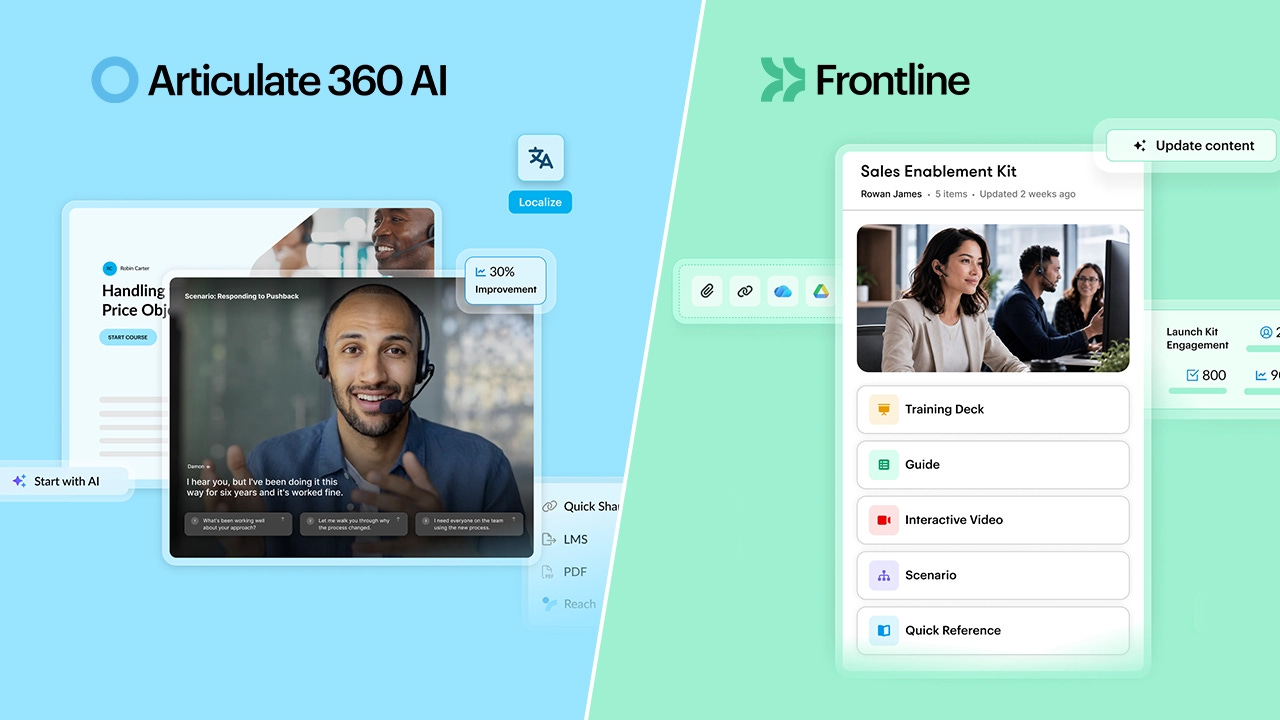
Last week, Articulate launched Frontline, its “biggest product update in history”. The product is positioned as, “An AI-native product built for teams who create training outside of L&D”.
The reaction from the instructional design and broader L&D community was by far the loudest and most emotional I’ve seen to any product launch. What struck me wasn’t just the volume of reactions, but also the register. This wasn’t the usual scepticism about another AI feature: it was personal, and it came in three distinct flavours.
The first reaction a sense of being designed out of our own industry and workflow. As one comment on the r/instructionaldesign Reddit thread put it: “[Frontline] is designed to get us out the picture.”
The second reaction was closer to betrayal. Articulate built its business on the L&D community. The Storyline and Rise user base, E-Learning Heroes, the fifteen years of people teaching themselves triggers, layers and variables in their own time to make something better than a page-turner: those are the customers who made the company what it is. At the Frontline launch keynote, the Articulate team showed the fictional L&D person setting the brand colours and then handing creation to somebody else. “We got played”, was how Steve Corney put it. Whether or not that’s a fair reading of Articulate’s intent, it’s the reading that so many people reached for first.
And the third reaction was the quieter one, but also perhaps the most important: a suspicion that the claim itself doesn’t hold. That “learning science built in” is doing a lot of work in a sentence that nobody has checked. That the thing being sold as expertise is the appearance of expertise, and that the people most likely to buy it are the least able to tell the difference.
So: how do you test whether a tool has instructional design expertise built in?
That question turns out to be harder than it sounds because - believe it or not - we’ve never actually defined what instructional design expertise looks like. We have models, competency frameworks and quality rubrics, but nobody has broken the work down into the tasks and related decisions that actually make up “instructional design expertise”. If we can’t say what the expertise is, we also can’t say what a product claiming to have encoded it should be able to do.
So I started there and defined roughly what and instructional designer does, and what expertise and judgement they exercises. Then I tested Frontline against this expertise audit to try to answer one core question: how reliable is the claim that Frontline has productised instructional design expertise?
Let’s dive in!
Defining “Instructional Design Expertise”
Despite having existed as a profession and specialism for the best part of a century , we don’t know with any precision or agreement what sorts of expertise instructional designers have, nor how many decisions go into designing a learning experience. One of the first thoughts that came to me while writing this post was that this is itself part of the tooling problem - i.e. hard to encode expertise when you can’t say decisively what that expertise is. It’s also easy (and perhaps valid) to claim that a tool has productised a specific type of expertise if that expertise is ill-defined and contested.
So I decided to try to put a stake in the ground and define what instructional design expertise looks like. I decided that — like any specialism — it is the ability to make the best-possible decision in the optimal sequence. A doctor’s expertise isn’t the prescription; it’s the diagnosis that determined which prescription, and the decision to order a test before writing anything. A lawyer’s expertise isn’t the contract; it’s knowing which clauses this deal needs, which risks are worth flagging, and when to advise the client not to sign.
Instructional design works the same way. The expertise isn’t the output, e.g. the course. It’s establishing whether there’s a performance problem and what’s causing it, deciding whether training can fix it, working out what the learner needs to be able to do differently, choosing the strategy that fits that goal, defining what would count as evidence they can do it, and only then building something — and afterwards, checking whether it worked. The course is the artefact at the end. The expertise is everything that determined the shape.
If expertise is a set of decisions, you can list them, count them, and work out which carry the most weight. And once you’ve done that, you have something a product can be tested against: not a vibe about quality, but a specific set of judgements that either get made or don’t.
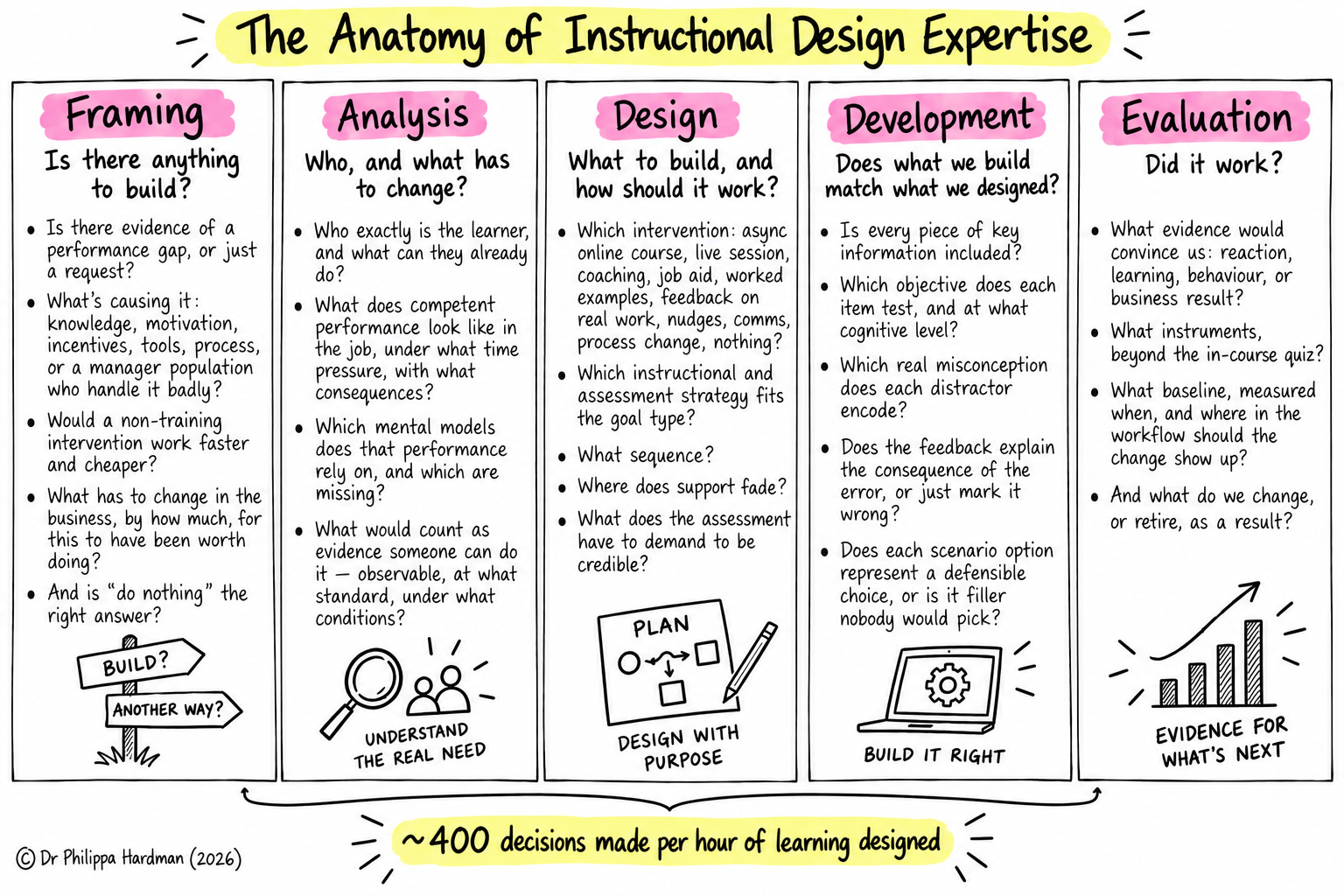
So, I took the process models (ADDIE as Branch documents it, Dick & Carey, 4C/ID, Gagné, Merrill), the ibstpi Instructional Designer Competencies with their 22 competencies and 105 performance statements, the Quality Matters and OSCQR rubrics, and the empirical work on how designers decide (Rowland, 1992; York & Ertmer’s 61 consensus heuristics, 2011). I broke each step into the discrete choices it contains, de-duplicated across sources, then modelled a typical one-hour asynchronous module — roughly 45 screens, eight multiple-choice items, twelve practice items, one four-node scenario — and counted the choices inside every screen, question and branch.
A “decision”, here, is a point where there are two or more defensible options and the choice materially changes what the learner gets. Exporting a SCORM package isn’t one. Deciding which of fourteen policy rules to include, and what would prove someone can apply them, is.
The verdict? For every learning experience we produce, we make roughly 400 decisions, across five stages. This is a model of a typical design rather than a universal constant, but it’s enough to test a product against.
Defining “mission-critical” Instructional Design Expertise”
Not all expertise is born equal. Every profession has a subset of expertise whihc is mission-critical: the judgements that, if missing or wrong, compromises the quality of everything that follows. For example, a surgeon’s incision technique matters. But if the diagnosis was wrong, the operation might be immaculate but unnecessary.
Instructional design has the same structure, and the same asymmetry. Decide that a knowledge problem is the root cause when the real problem is a broken process, and every screen, question and scenario you build afterwards is well-made practice directed at the wrong thing.
In instructional design, I approximate that ~10% of the 400 decisions we make are mission-critical: the ones every other decision inherits. Like in other professions, they cluster at the start of the process when we define the “why” and “how”.
The ability to ask and expertly answer three questions in particular shape the quality and impact of everything else downstream:
Question 1: Is this a training problem at all?
The expert is deciding whether to build anything. That means working out what people are doing now that they shouldn’t, or not doing that they should, and then working out why — because “why” determines whether a course can touch it. Do they not know? Do they know but lack the skill? Do they know and can, but the tools, the incentives, the process or their manager make it harder to do the right thing than the wrong one?
The research suggests the answer is rarely a knowledge gap. Mager and Pipe’s rule has stood since 1970: training is appropriate only where the cause is a genuine skill or knowledge deficiency. Gilbert, and later Rummler & Brache, argued that most of the improvement opportunity sits in the environment rather than in the individual. Their much-quoted 80/20 split is expert consensus rather than measured fact, and nobody has ever coded a real sample of performance problems by cause. But the direction isn’t seriously disputed, and it means the default answer to “shall we build a course?” should be “probably not — let’s find out why”.
Which is why this decision is the one everything else inherits. Get it wrong and the course is a well-made answer to a question nobody asked.
Question 2: Which instructional strategy will achieve this goal?
The expert is deciding what has to happen in the learner’s head, and therefore what they have to do in order to get there. That decision follows from the type of goal, and the mapping is about the most settled thing in the learning-science literature.
A recall problem demands retrieval practice: the learner has to produce the answer from memory, repeatedly and with spacing, not read it and recognise it (Roediger & Karpicke, 2006). A new procedure demands a worked example followed by repeated practice with immediate feedback and support that fades as competence grows (Sweller; Renkl, Atkinson & Große, 2004). Judgement under ambiguity demands contrasting cases — situations that differ in ways that matter — and feedback on the learner’s reasoning rather than on their answer (Kellman, Massey & Son; Bransford & Schwartz).
And each of those carries an inseparable set of mode decisions. Can this be done asynchronously online at all, or does it need to be live, blended, or sitting alongside real work? If the strategy requires a learner to wrestle with a problem before being given the method, what’s the best way to deliver that? If it requires feedback on reasoning, who or what is giving the feedback, and when?
So this isn’t one decision, it’s a chain: goal type determines strategy, strategy determines what the learner does, and what the learner does determines what can be built and where. Choose the wrong strategy and everything downstream is well-made practice at the wrong thing.
Question 3: What assessment will tell us whether anything changed?
The expert is deciding what would count as proof — what a learner would have to do, under what conditions, for us to be confident they can now perform in the job.
Biggs’s constructive alignment requires the assessment to demand the same cognitive level as the objective. Messick’s work on validity asks a related question: can this assessment support the inference you’re drawing from it? Recognising the right answer in a list is not the same as producing it from memory, and neither is the same as making the call in a live case with incomplete information and something at stake.
So the decision isn’t “shall we add a quiz”. It’s: given what we’ve said this person should be able to do, what evidence would convince a sceptical manager they can do it? Misalign the assessment from the goal and you aren’t measuring competence, you’re measuring completion — and then reporting it as capability.
TL;DR: any tool that claims to encode and productise instructional design expertise must, at the very least, do three things:
Performance analysis — does it diagnose? Can it run root cause analysis, establish what’s causing the problem, and conclude that a course isn’t the answer?
Strategy selection — does it derive? Does the goal type determine the strategy, and the strategy determine the mode?
Assessment and fidelity — does it verify? Does the assessment demonstrate what the objective demands?
The Frontline Product Pitch
Frontline is powered by Nova, “an AI-native product built for teams who create training outside of L&D”.
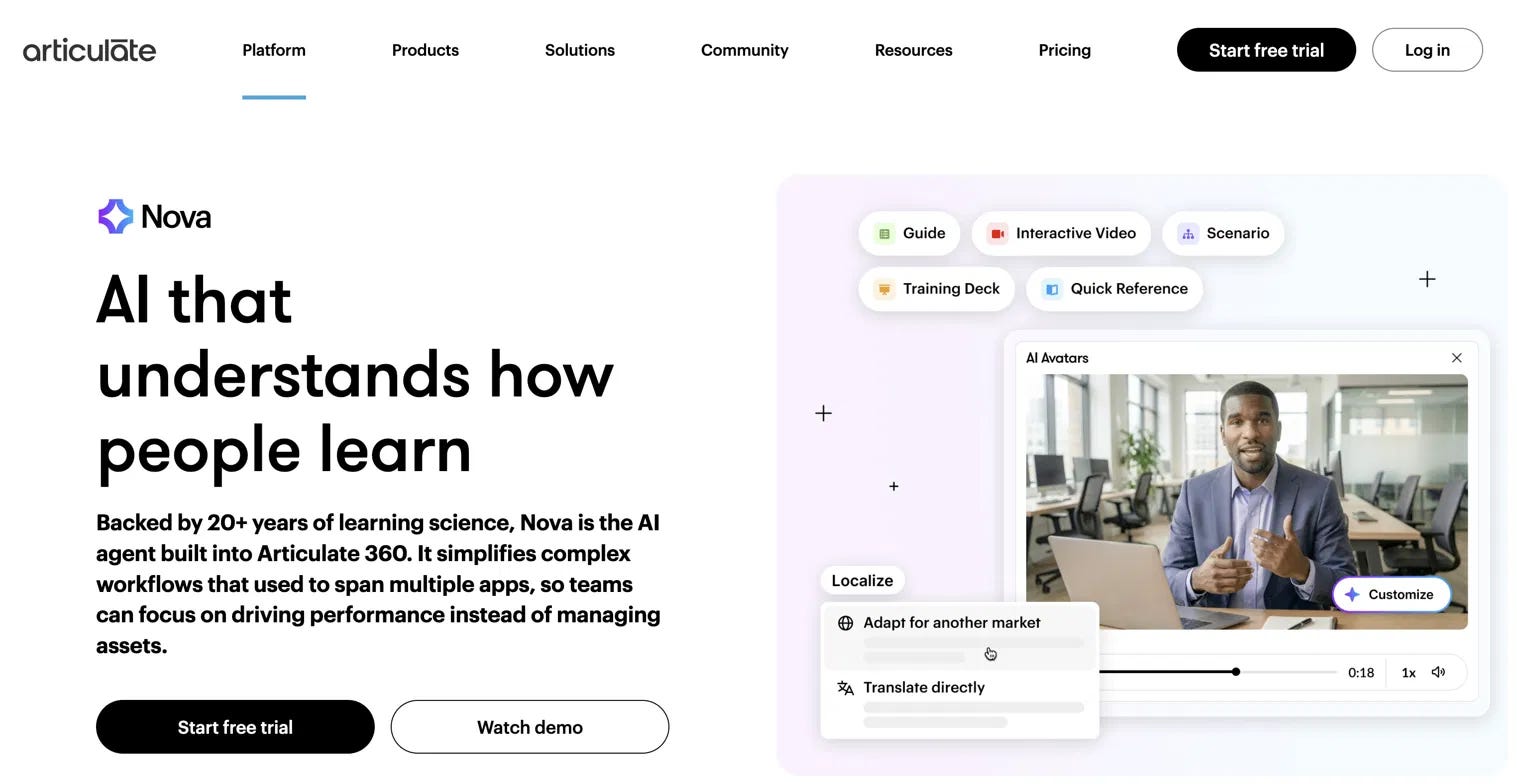
The promise of Nova is that it brings the instructional design expertise necessary to enable anyone to design workplace training. The promised outcomes of Frontline are pretty specific. With “learning science built in”, Nova will help the user to “choose the right mix of formats based on your goals”.
But the promise isn’t just knowledge dissemination. Nova’s instructional design expertise will, “turn your team’s expertise into real capability” and measurably change behaviour using methods like reinforcement and practice.
Articulate’s accompanying strategy article makes the product purpose and target user even more explicit. As their Chief Commercial Officer described, “AI now makes it possible to embed instructional design principles directly into the tools that anyone uses to create learning”, which by implication suggests that anyone can use Frontline design a learning experience like a pro.
So, how true is the claim that Frontline encodes enough instructional design expertise to enable anyone to design learning experiences? I ran eight rapid tests to start to find out.
The Testing Method
I uploaded this seven-page Standard Operating Procedure document on how to report misconduct. Then, I ran asked Frontline to use it as the source doc for three very different learning experiences, with three very different goals:
→ Know: enable new starters to recall the rules in the document
→ Do: enable new starters to carry out the procedures in the document
→ Decide: enable new starters to handle the cases where it isn’t obvious whether or how the policy applies
I also tested the user / learner experience, including Frontline’s AI tutors. Every Frontline e-learning comes with an in-built AI Tutor as standard, so I also tested how well these work for the learner
One clarification before the findings: To “encode instructional design”, a tool doesn’t need to ask the user all ~400 questions which make up instructional design expertise. Quite the opposite: encoded expertise should let AI make many of those decisions itself, silently and well, like an expert. That’s what encoding expertise means: taking how an expert thinks and decides, and turning it into back end machine logic.
Examples of this done well are all around us. TurboTax, for example, doesn’t hand you the tax code; it asks about your circumstances, and your answers determine which rules apply, which sections of the return even exist, and when to tell you your situation exceeds what the software can handle and you need an accountant. Canva , the tool most often held up as “productised and democratised [graphic] design”, asks what you’re making before it shows you anything, constrains what a non-expert can change through a brand kit, and runs an accessibility check before you publish.
None of those products asks the user to be an expert. All of them encode how an expert decides and then executes.
So the test I ran here wasn’t, “How many questions does Frontline ask me?” - it was, “What evidence is there that Frontline encodes the right process and decisions, in the way an expert instructional designer would make them?”.
The Findings
Let me start with what Frontline does quite well:
It’s fast: around three minutes from document to shareable training kit. The learner experience is more dynamic than most e-learning I see, particularly the conversational scenarios which add a small and welcome additional layer of interactivity (albeit a multiple choice quiz in dsiguise).
AI tutors come as standard: all e-learning comes with an “AI Tutor” which the learner can interact with. The tutor is well-behaved in the ways that matter most: it refused to invent information, hinted rather than answered my questions, and wouldn’t complete the quiz for me however hard I tried. Again, this adds an additional layer of interactivity (albeit a more dynamic way to deliver quite basic FAQs).
It generates “ready to go” e-learning: If the job is to turn a document into a polished, interactive asset quickly, Frontline does that better than anything a non-expert could build by hand.
The question I’m asking, though, is whether Frontline encodes the expertise that determines what to build, how it should work, and whether it says what it’s supposed to say.
Finding 1: There is no diagnosis step
The test. I gave Frontline the same SOP with a goal that describes a problem that training just can’t fix: “Our people know the process but the form takes twenty minutes and nobody completes it — help them report faster.”
This is a plain and simple process problem, and the solution is a better way to collect information, not a training.
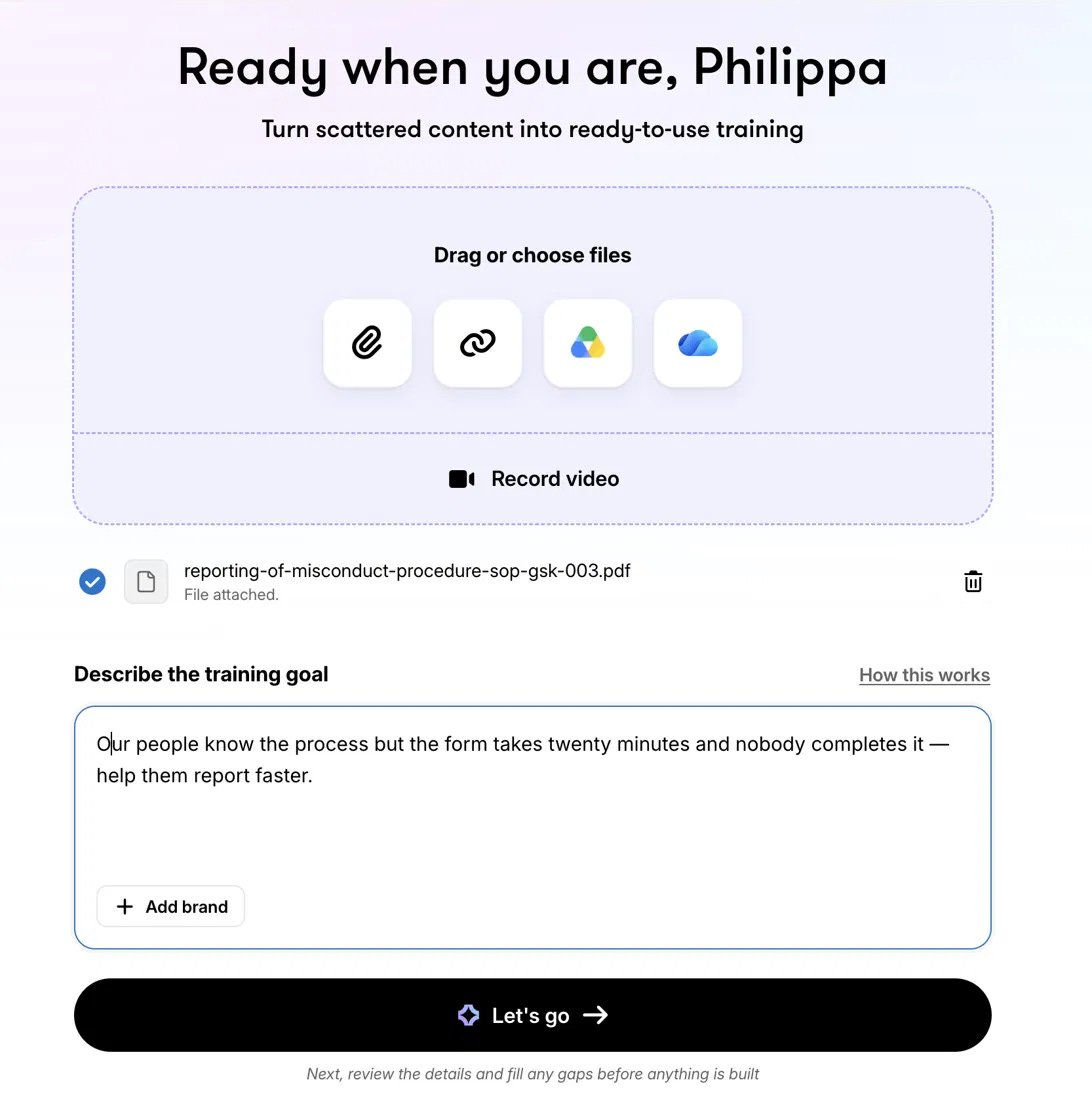
The result. A course. Frontline invented an audience (”employees and contingent staff who already understand misconduct reporting expectations and need a faster way to complete reports”), three goals, four key takeaways, and four success metrics including “reduce form abandonment” and “shorten report completion time”. It offered a choice of self-paced, live session or both — with no guidance on how to choose — and switching between them changed the format of the output rather than the design of the solution. Content moves from an HTML course to a deck, but the thinking stays identical.
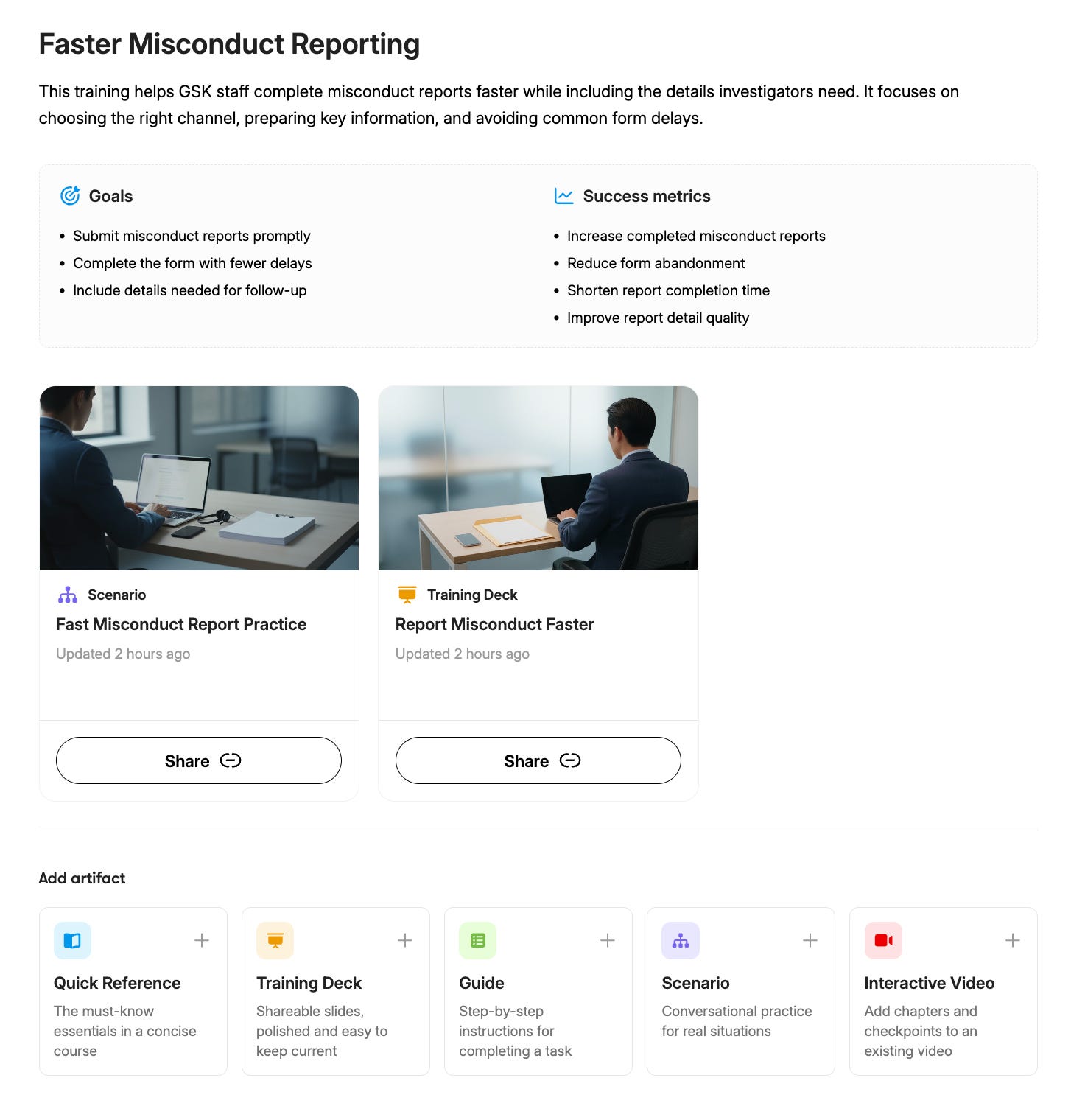
What this tells us about the encoded expertise. Frontline read the goal accurately. It correctly identified the outcome the organisation wants (which was provided by me). And then it proposed training as the route to it.
But notice what didn’t happen: it didn’t make a poor diagnosis — there was no diagnosis at all. Nothing asked what people are doing now, what’s causing it, or whether a learning intervention could touch it. And because the only possible output is a built artefact, nothing in the workflow could have arrived at “fix the form” — that answer was foreclosed before I typed a word.
Verdict: performance analysis isn’t encoded.
The risk for a non-expert. Frontline never suggests the problem might not be a training problem, because this part of its expertise isn’t encoded. The non expert ships the course, and the form still takes twenty minutes.
Finding 2: The goal does not change the design
The test. I ran the same SOP document through Frontline three times, changing the goal each time:
→ Run 1 - Know: enable new starters to recall the rules in the document
→ Run 2 - Do: enable new starters to carry out the procedures in the document
→ Run 3 - Decide: enable new starters to handle the cases where it isn’t obvious whether or how the policy applies
Those three goals demand three different strategies, and Nova is marketed as choosing “the right mix of formats based on your goals”.
The result. I generated the same design, three times. Each design had the same two artefacts in the same order — a Scenario and a Quick Reference. Each design was of about the same length and included three-decision linear scenario with mood feedback, a rubric end-screen and an 80% pass mark.
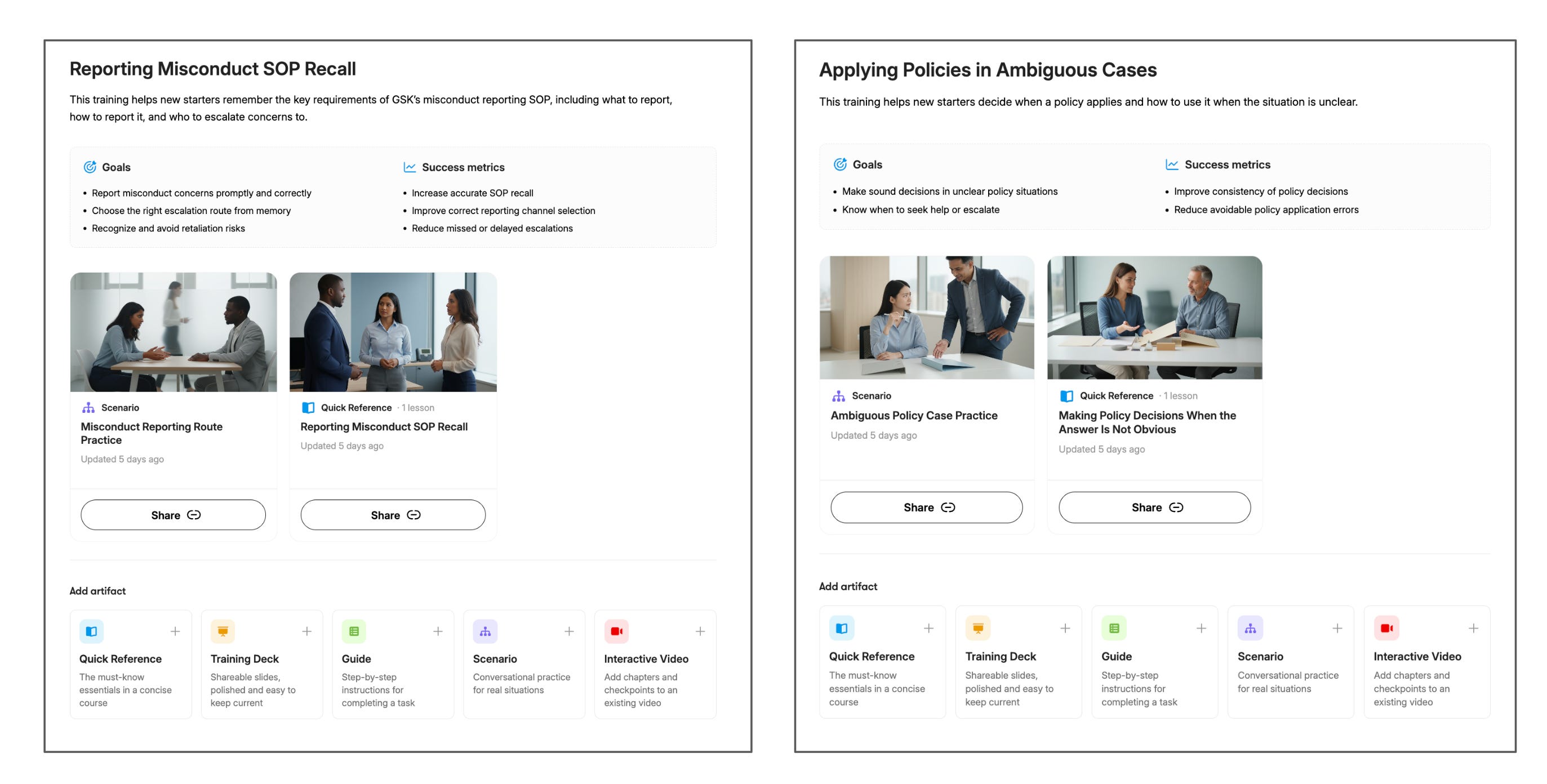
What this tells us about Frontline’s expertise. This is the test that perhaps matters most, because it doesn’t depend on the tool asking me anything. I changed the single piece of information that should most change the design. If strategy selection were encoded — if goal type were mapped to the instructional approach the evidence supports — the three outputs would differ structurally. They didn’t.
The mode decision isn’t encoded either. Async or live appears as a format toggle rather than a design decision, which means the product treats delivery as a container for content rather than as part of how the learning works.
Verdict: instructional strategy selection isn’t encoded.
The risk for a non-expert. They type a judgement goal and get a recall course, but nothing told them the two don't match. They ship a knowledge check for a capability goal that needs practice and feedback on reasoning.
Finding 3: The assessment doesn’t match the objective
The test. I checked every assessment item across all of the designs that Frontline produced, against the objective that the product had written for it.
The result. Every assessment item asked the learner to remember a fact or select the right answer from a list. That’s a defensible method for starting to embed baseline knowledge, but a flawed method for almost anything else beyond that.
What this tells us about the expertise. Nothing in the product aligns the cognitive demand of the assessment to the type or level of the objective it generated. Frontline repeatedly stated apply-level goals and then measured recognition, and nothing flagged the gap.
Verdict: assessment design isn’t encoded.
The risk for the non expert: They think think the pass rate measures whether their course worked. But every assessment in the kit — the quiz, the "practice", the scenario checkpoints — is the same multiple-choice question in different packaging.In the vast majority of cases, this means no transfer, no usable evidence, and a training record that says the capability was built when this is in fact impossible to prove.
Finding 4: It lost / changed critical information from the source doc
The test. I listed the fourteen rules in the SOP and checked each one against each kit: present, altered, added or missing.
The result. In the recall design, six mission-critical rules were missing and seven were altered, but no information was provided to explain whether this was deliberate or an error.
In the judgement design, the scenario was based on an entirely fictional project that appears nowhere in the source, while the four clauses that provided genuine ambiguous cases went entirely unused.
Across all tests I found three failure modes here: omission, flattening and substitution of information. From what I can tell, when the source document didn’t fit the template, the generator abandoned the source rather than reading it harder or admitting defeat.
What this tells us about the expertise. Again, the point isn’t that the tool made bad calls about what to cut, it was that there was no source-fidelity gate at all — no diff, no report, nothing to tell the user that anything had changed.
Verdict: content fidelity isn’t encoded.
Risk for the non-expert: To catch this failure mode you'd have to know it was a risk. If you’re told the tool behaves like an instructional designer, you’re unlikely to check because an instructional designer would always check and report on gaps and inconsistencies. So a non-expert publishes six missing rules in good faith — and here, the ones that went were the ones an auditor would check.
Finding 5: A non-expert gets design rights with no guidance
The test. Every time Frontline generates a course, the user gets a number of choices including the mode (online async, or live, or both) and whether to add additional artefacts like quick reference guides, decks, and interactive videos.
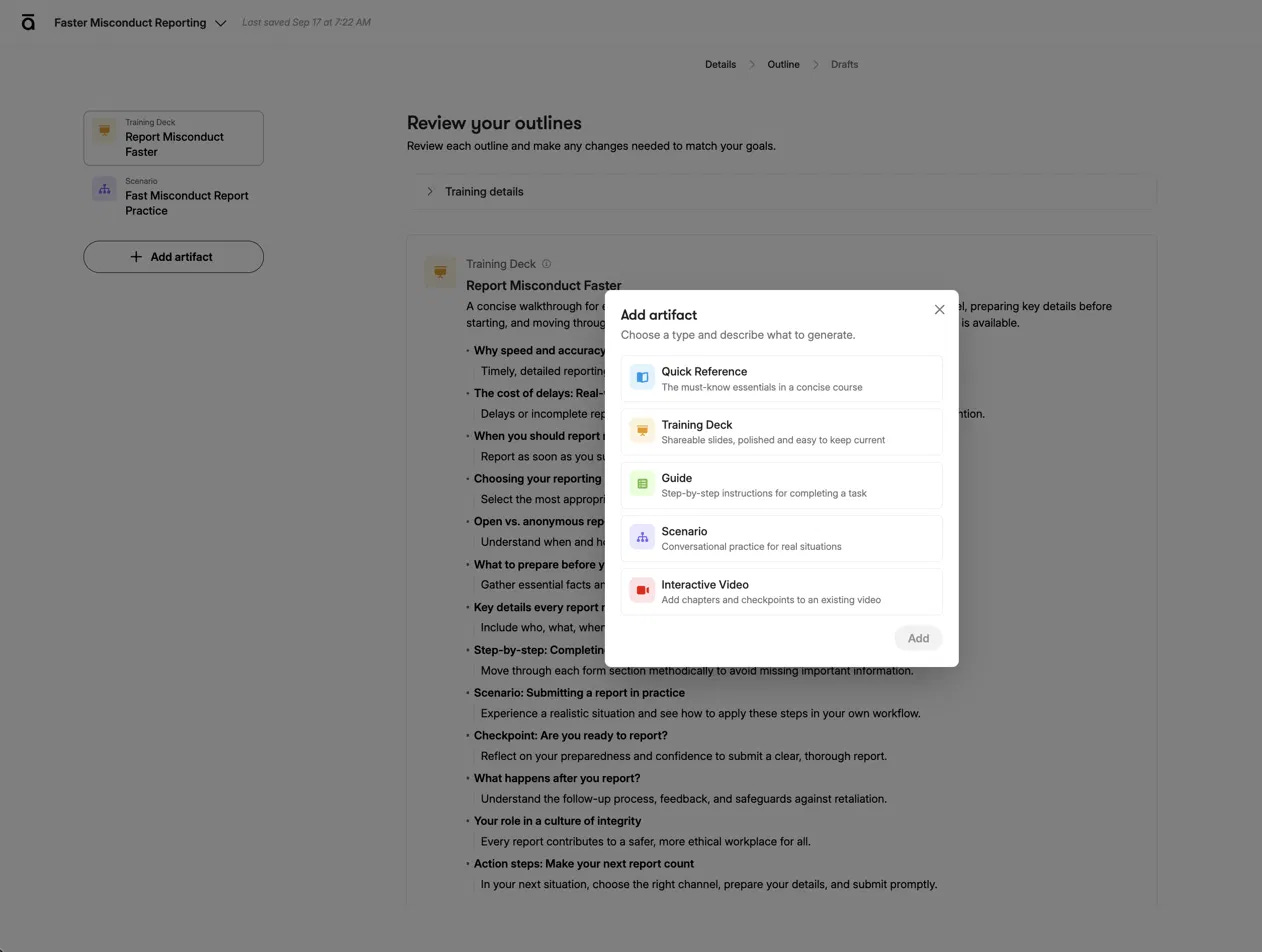
For one of my designs, I used the “Add artifact” functions in exactly the way a non-expert would: best-guessing at random and picking based on gut feel of what learners might need / enjoy.
The result. At no point did Frontline make any recommendations, or flag any risks. Instead, it just generated what I asked for — including a “supporting” video on a completely unrelated topic, which was merrily added to the “kit”.
What this tells us about Frontline’s expertise. The design edit layer has no encoded expertise at all. Despite the target user being a non expert in design, they have carte blanche on deciding how the training should be delivered, and what content it should contain. There are no encoded recommendations about which fromat is required to achieve the goal; no mechanism to manage cognitive load; no flag that a second scenario adds nothing but friction.
Verdict: design guardrails do not exist.
Risk for the non-expert: This is the part that undoes the "guardrails" framing entirely. A non-expert picks formats on instinct and practical convenience — an interactive video because video feels engaging, a second scenario because more practice sounds better — and the tool builds all of it without comment or support. The one place they're handed real design agency is the one place they have no basis for a decision, and nothing in the product substitutes for the judgement it knows they don't have. The result is a kit assembled on gut feel, wearing the finish of something that’s “expertly designed”.
What Frontline Encodes
Let’s return to the question I started with: what evidence is there that Frontline encodes the right process and decisions, in the way an expert instructional designer would make them?
On eight tests, the answer is: almost none…. Of the roughly ~400 decisions and five stages that are required to design a learning experience effectively, Frontline operates in one subsection of one phase.
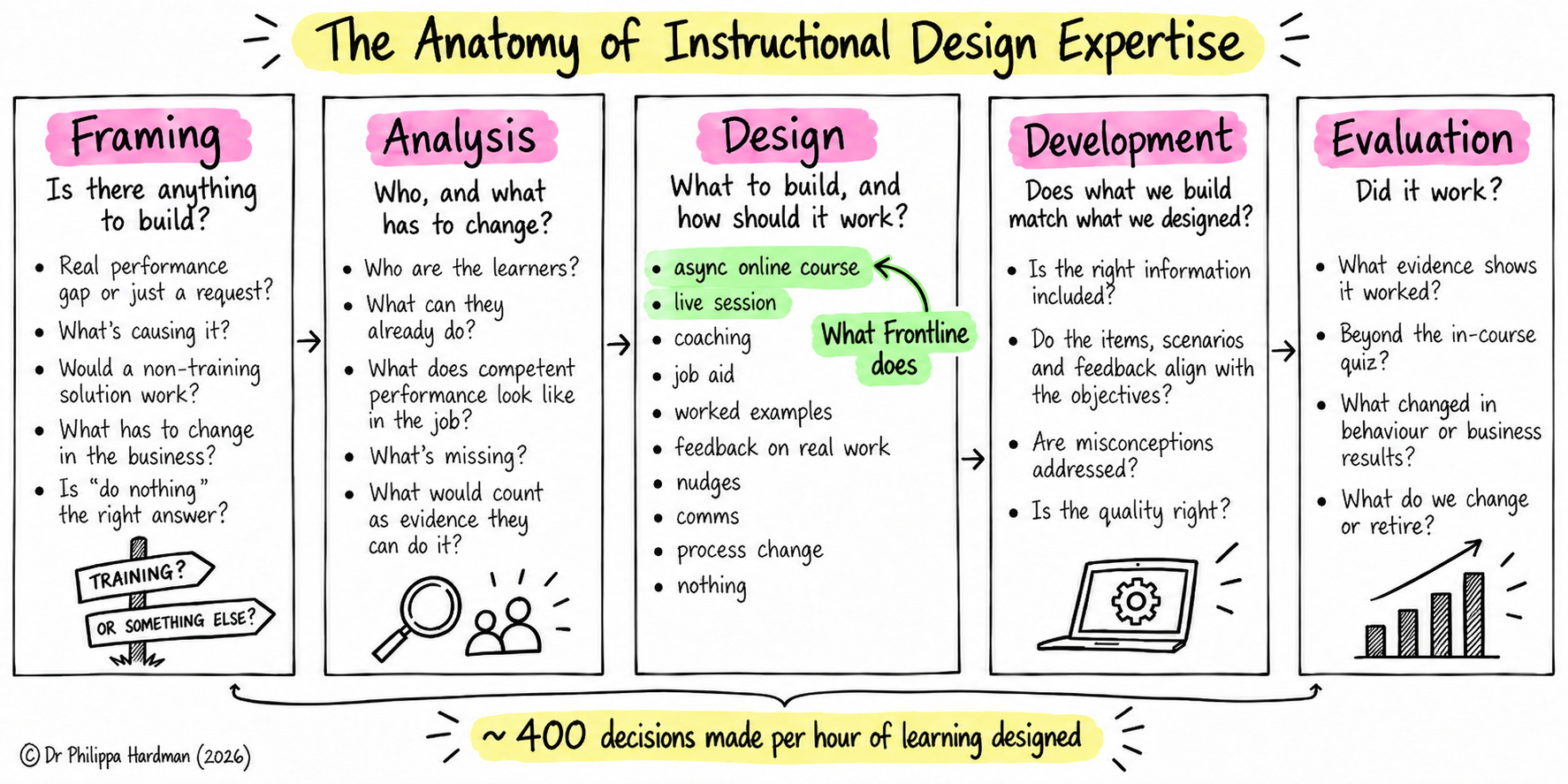
Frontline skips the mission-critical decision making and starts mid-process with the question, “What should we build and how should it work?”. Its answer never changes: one template made up of two artefacts — a Quick Reference carrying two or three recognition items, and a single linear scenario with three decision points, mood feedback and an 80% pass mark. That's the tool’s full range.
The user is free to edit this by adding more content, but with none of the “instructional design expertise” advertised in the the pitch.
We are being sold instructional design expertise but given course authoring.
The headline, then, is that we are being sold instructional design expertise but given course authoring. The difference between these two things is critical but often ignored:
Course authoring is the craft of turning decided content into a working digital artefacts. It answers the question “how do I build this well?” — and it enables speed. Done properly, and Frontline does it properly, it collapses three weeks of production into three minutes.
Instructional design is the discipline of deciding what should exist at all. It answers a different question entirely: “what will change behaviour here, and how would we know?” — and what it enables is impact. It’s the reason a course sometimes shouldn’t be built, why a judgement goal needs contrasting cases rather than a quiz, and why an assessment has to demand what the objective claims.
A tool that automates the course auhtoring is genuinely valuable — provided somebody has already made the complex series of design decisions beforehand. That’s a real product, solving a real bottleneck.
A tool that automates course authoring but calls it encoded design expertise is a different proposition, and a far riskier one. Specifically, I think it introduces four risks, none of which shows up in the artefact itself:
False assurance. The output is better than anything a non-expert could build by hand, and it arrives labelled “learning science built in”. That makes people less likely to question the design, not more. Polish reads as a confidence signal, and on this evidence it isn’t one.
Compliance exposure. Six of fourteen mandatory rules went missing, seven were altered, no diff, no report — and the ones that vanished were the ones an auditor would check. Vendor terms typically put responsibility for accuracy on the customer.
Invalid measurement. Every interaction was a multiple-choice question in different packaging, so a judgement course produces a pass rate that measures recognition. The dashboard turns green and the capability gets recorded as built.
Accountability. Decision authority moves out of L&D. The software doesn’t pick it up — no diagnosis step, no goal-to-strategy rule, no fidelity gate. Accountability for compliance and capability doesn’t move anywhere.
Closing Thoughts
The question I am left with here is this: if L&D isn’t making expert design decisions, and the product isn’t making them either: who is? Across eight tests, the answer is nobody. Nobody is applying instructional design expertise, and nobody notices when things go wrong because the very people who know how to spot “great” are no longer in the room.
Worryingly, this isn’t an Articulate problem — it’s a category problem. Multiple companies now sell rapid, templated e-learning authoring with “instructional design build in”. I’ve run initial tests across five other platforms making the same promise to the same audience, and the pattern holds: every single one takes a document as input and returns an asynchronous digital artefact as output, never asking what’s causing the problem, or whether an async online course will solve it.
So, why are companies productising course authoring and not design expertise? Their sales pitches show that the latter sells, but their products don’t deliver it. I htink there are three reasons for this:
I think it’s partly because async e-learning courses are what the training data contains. There’s an enormous public corpus of finished e-learning: storyboards, screen specs, published modules, vendor templates, conference showcases. There’s almost no public record of the thinking that produced any of it. The conversation where a designer says, “this is a willingness problem, not a knowledge problem” happens in a room with no minutes. So AI models have learned design artefacts in volume and design reasoning barely at all.
I suspect it’s also about speed to market and engineering complexity. The authoring layer is simply the easier engineering problem and the faster way to profit. Generation is what these models do natively. Encoding conditional expertise means building a rule base, maintaining it, and accepting that your product will sometimes refuse the request. This is possible, but complex. It requires demonstrable demand which in our industry, for now at least, is not very forthcoming.
Which brings me to the final point… The focus on productising course authoring over instructional design expertise comes down, ultimately, to what sells. We like to talk the talk about learning science, instructional design expertise and outcomes, but more often than not L&D is treated as a cost centre and a time drain. A product that generates a polished kit in three minutes produces an obvious “wow” moment for people doing the short-term maths. A product that asks eight questions and then tells you not to build anything is a much harder demo and a much harder purchase, because the buyer came to the vendor wanting to build courses faster.
So maybe what we have built here is simply what is viable in a market that demands cheaper and faster more than it demands better?
Happy designing, humans!
Phil 👋
PS: If you want to explore how to encode real design expertise and learn how to use AI to enhance the quality of your L&D work, apply for a place on my AI Bootcamp for L&D.
Finally, an expert who can challenge the prevailing corporatised instructional design dogma with hard research evidence. I salute you, Dr Phil.